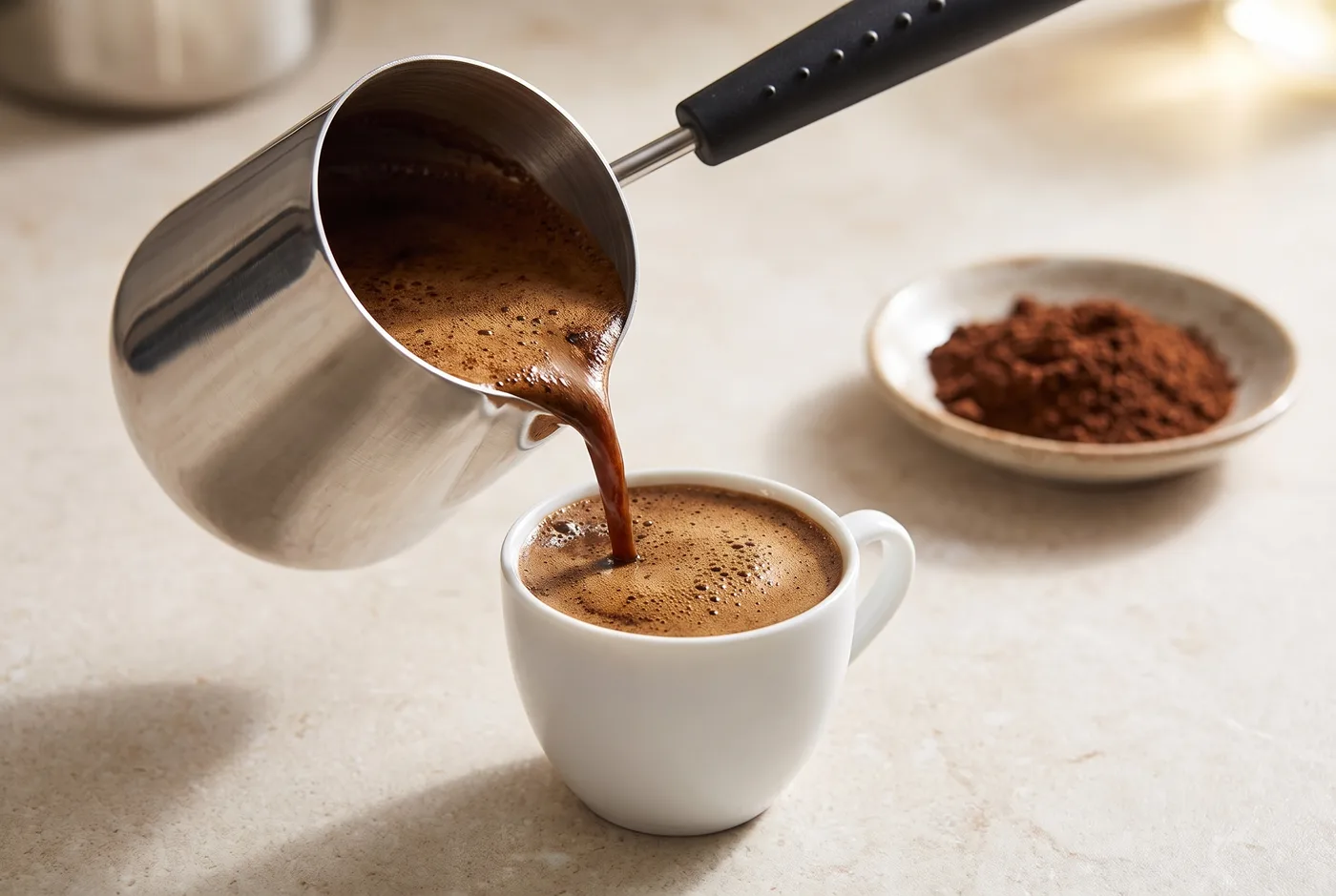
The cezve is the only equipment Turkish coffee requires — a small, long-handled pot with a wide base and narrow neck, built to heat coffee slowly and raise the foam the method is known for. Get the right one and it lasts decades.
The best Turkish coffee pot for most people is a 12 oz stainless steel cezve: it brews two to three cups, never needs polishing, lasts for decades, and warms milk or hot chocolate as easily as coffee. It is the one we brew with, the 12 oz Lezzet cezve ($20, for gas, electric coil or ceramic cooktops, not induction). If you want the most traditional pot and the best foam, choose a tin-lined hammered copper cezve and give it a little more care. Either way, the shape matters more than the metal: wide base, narrow neck, pour spout, long cool handle.
How Do You Use a Cezve?
Spoon about 7 g of powder-fine coffee into the cezve with 60–70 ml of cold water, plus sugar if you take it, and stir once. Set it on low heat and lift it off when the foam rises. Then pour, foam first.
The Best Turkish Coffee Pots, by What You Need
Best for most kitchens
12 oz stainless steel cezve
Brews two to three cups, goes in the sink without a second thought, and never tarnishes. The foam is a touch less lofty than copper's, but with low heat and good coffee you will not miss it. Ours is the 12 oz Lezzet cezve, with a pour spout and a covered handle, for gas, electric coil or ceramic cooktops.
Best foam and most traditional
Hammered copper, tin-lined
Copper spreads low heat the most evenly, which is why it builds the thickest foam and why it has been the classic choice for centuries. Choose one lined with tin inside and with a long wooden or brass handle. It needs hand washing and an occasional polish.
Best for induction cooktops
A cezve rated for induction, or a converter disk
Copper and brass will not work on induction, and plenty of stainless pots will not either. Buy one whose listing says induction-ready, with a magnetic base wide enough for your burner, or set any cezve on an induction converter disk.
Best for a first-timer or a gift
A cezve with the coffee
The pot is only half of it. Our Turkish Coffee Kit packs the 12 oz cezve with powder-fine Lezzet coffee, so the first cup works the day it arrives.
What about an electric Turkish coffee maker?
Electric machines heat the coffee and switch off on their own when the foam rises. They are convenient if you make many cups a day, but they cost several times more than a cezve, take counter space, and give you less control over the foam. A cezve on low heat makes the same cup in about the same few minutes, and it is how Turkish coffee has always been made.
What Is a Turkish Coffee Pot Called?
The Turkish name is cezve — pronounced jez-veh, and often spelled jezve, jezveh, or cevze in listings. The same pot goes by different names around the region, and sellers use them interchangeably: if it has the wide base, narrow neck, and long handle, it is the same tool.
| Name | Where it's used | Notes |
|---|---|---|
| Cezve | Turkey | The original Turkish name; what most quality pots are sold as |
| Ibrik | Common in Western listings | Technically a water pitcher in Turkish, but widely used for the pot |
| Briki | Greece | Same pot, used for Greek coffee — the identical brewing method |
| Rakwa | The Levant | Also seen as rakweh; the pot for Levantine Arabic coffee, often taller with a longer spout |
| Džezva | The Balkans | The Bosnian and Balkan spelling of the same Ottoman-era pot; for Bosnian coffee it comes to the table with the coffee still in it |
An Arabic coffee pot with a tall, curved spout is a dallah: the serving pot for Gulf qahwa, and a different tool from a cezve. Our guide to the dallah and the rakweh explains which Arabic coffee each one makes.
Copper vs Stainless Steel vs Brass
| Copper | Stainless Steel | Brass | |
|---|---|---|---|
| Heat & foam | Fast, even heat; best foam | Slower, less even; good foam | Close to copper |
| Stovetops | Gas, electric — not induction | Gas, electric coil, ceramic; induction only when the base is magnetic and the diameter is recognized | Gas, electric — not induction |
| Care | Hand wash, occasional polish | Easiest; very durable | Hand wash, tarnishes faster |
| Price | $15–25 | $10–25 | $20–40 |
| Best for | Best foam and tradition | Everyday use, easy care, and warming milk or hot chocolate; induction only when explicitly compatible | Display and tradition |
Traditional copper cezves are lined with tin, which is why the inside looks dull grey while the outside shines. That lining is supposed to be there — it keeps copper out of contact with your coffee, so never scrub it off.
What Size Cezve Should You Buy?
A Turkish coffee cup is small, about 60–70 ml of water. A cezve also needs headroom: fill it only about half to two-thirds full, because the foam climbs the neck as it heats. So choose by the cups you actually brew at once:
- 6–8 oz (about 200 ml): one cup, for brewing just for yourself
- 12 oz (about 350 ml): two to three cups, the right size for most people
- 16–20 oz (500 ml and up): four or more, for households that serve guests
Size matters more than it looks. One serving in a large pot spreads too thin to build proper foam, and a pot filled to the brim spills over the moment the foam rises. Our 12 oz cezve is sized for the two-to-three-cup sweet spot.
Handle, Shape, and Spout
Handle: long, and made of something that stays cool — wood or brass. You will hold the cezve over heat for minutes at a time, so avoid short handles.
Shape: wide at the bottom, narrow at the neck. The taper is functional, not decorative — it concentrates the rising foam instead of letting it spread and collapse. Skip straight-walled pots sold as cezves.
Spout: a small pinched spout lets you pour slowly enough to keep the foam on top of the cup instead of breaking it.
Does a Cezve Work on Induction?
Copper and brass are not magnetic, so an induction burner will not detect them without a converter disk. Stainless steel is not automatically induction-compatible either: the base must contain enough magnetic material, and its diameter must meet the cooktop's minimum pan-detection size. Check both the pot listing and your cooktop manual before buying. The 12 oz Lezzet stainless steel cezve is not induction-compatible; use it on gas, an electric coil, or a ceramic cooktop.
Our Pick
For everyday brewing, a 12 oz stainless steel cezve. It is the pot we use and the one in every Turkish Coffee Kit: two to three cups, a spout that pours the foam cleanly, and nothing to polish. If tradition and the last bit of foam matter most to you, a tin-lined hammered copper cezve in the $15–25 range is the classic. Handmade $60 pots are beautiful, but they brew the same coffee.
What separates a great cup from a flat one is the coffee and the technique, not the pot. A simple cezve with fresh, powder-fine Turkish coffee beats an ornate pot with stale grounds every time. Once you have the pot, our step-by-step guide covers the heat, the timing and the foam.
The same pot does more than plain coffee. A crushed pod in the cold water makes cardamom coffee, a pinch of ground cinnamon mixed into the grounds makes cinnamon coffee, and because a cezve leaves the grounds in the cup, it is also where reading coffee symbols begins.
How to Care for a Copper Cezve
- Hand wash only — never the dishwasher.
- Dry immediately after washing to prevent water spots.
- Polish the outside with lemon juice and salt when it dulls.
- Leave the grey tin lining inside alone — no abrasive scrubbers.
Turkish Coffee Pot FAQ
What is a Turkish coffee pot called?
A cezve (jez-veh). The same pot is called an ibrik in much of the West, a briki in Greece, and a rakwa in the Levant — different names, same small long-handled pot.
Cezve vs ibrik — is there a difference?
Not in practice. In Turkish, an ibrik is technically a water pitcher, and the coffee pot is the cezve — but outside Turkey, "ibrik" became the common listing name for the same pot. If it has the wide base, narrow neck, and long handle, cezve and ibrik are the same tool; buy by shape, not by name.
What is the best Turkish coffee pot?
For most kitchens, a 12 oz stainless steel cezve: two to three cups, no polishing, built to last. Hammered copper builds the best foam and is the traditional choice, with a little more care. Look for a wide base, narrow neck, pour spout and a long cool handle.
What size cezve should I buy?
A 12 oz (about 350 ml) cezve for most people, which brews two to three small cups. Fill it about half to two-thirds full so the foam has room to rise. For one cup only, a 6–8 oz pot is enough.
Is copper or stainless steel better for a cezve?
Copper heats more evenly and builds the best foam; stainless steel is more durable and easier to maintain. For induction, the stainless base must be magnetic and wide enough for the cooktop to recognize. Our 12 oz stainless steel cezve is not induction-compatible and is for gas, electric coil, or ceramic cooktops.
Does a copper cezve work on an induction stove?
No — copper is not magnetic. Use an induction converter disk or a cezve explicitly rated for induction, with a magnetic base and a diameter your cooktop can recognize. Stainless steel by itself is not a guarantee of compatibility.
Is an electric Turkish coffee maker better than a cezve?
Not better, just more automatic. Electric machines stop when the foam rises, but cost far more and give you less control. A cezve on low heat makes the same cup in about the same time.
Can I make Turkish coffee without a cezve?
Yes, any very small saucepan works. You lose some foam without the narrow neck, but grind, low heat, and technique matter more than the pot.