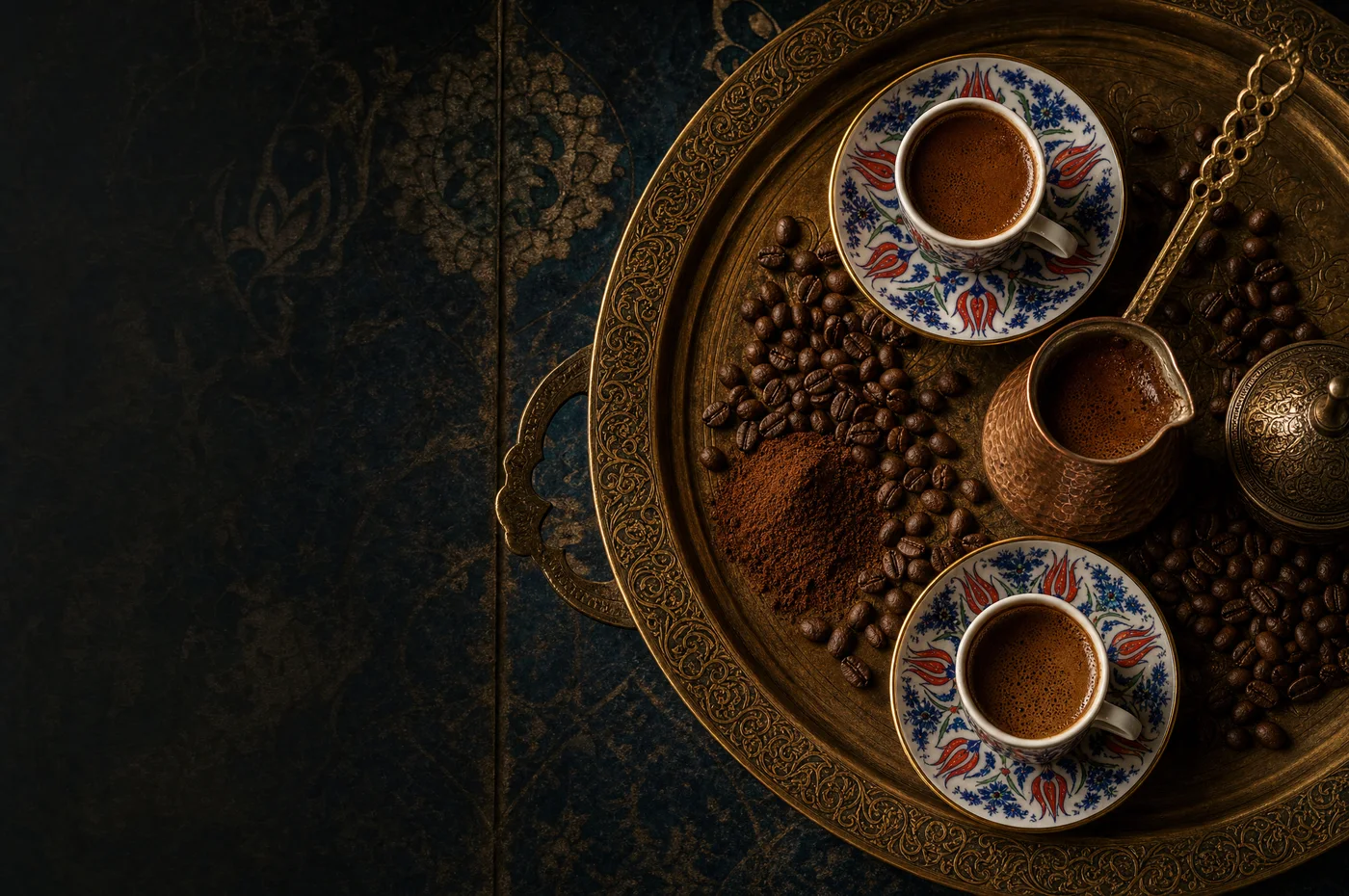
Turkish, Greek, Arabic, Bosnian and Armenian coffee are one way of making coffee with five names. Each starts with coffee ground as fine as powder, cold water and a small long-handled pot, heated slowly until a foam rises, then poured unfiltered so the grounds settle in the cup. The method became an everyday ritual in the coffeehouses of 16th-century Istanbul, with coffee that came out of Yemen, and from there it traveled across the Ottoman lands. Every place it reached kept the method and gave it a name and a pot of its own.
This is the story of that one cup: where it started, how it spread, what each country calls it, and why one coffee still works for all of them.
Where Did Turkish Coffee Come From?
Coffee drinking begins in Yemen. By the late 1400s it was well established among Sufi communities there, who drank it to stay alert through their night devotions. Yemen grew the coffee and shipped it from Red Sea ports such as Mocha, and the drink moved north with it. By the early 1500s it had reached Mecca, Cairo and Damascus, where coffeehouses were already popular meeting places.
Istanbul, the Ottoman capital, had coffee by 1539. In 1554, according to the Ottoman chronicler İbrahim Peçevi, two men from the coffee cities of Syria, Hakem of Aleppo and Şems of Damascus, opened a coffeehouse in the city. Coffeehouses multiplied quickly after that. They became places to talk, play chess and backgammon, listen to stories and music, and hear the news, and the coffee they served became the city's daily habit.
That cup is the one this page is about. Put plainly, it is freshly roasted beans ground to a fine powder, then coffee, cold water and sugar put into a pot together and brewed slowly to produce the foam, served in small cups with a glass of water. That is Turkish coffee, and the rest of this story is that same method moving outward. If you want the route the beans took to get there, our post on the trade routes from Yemen to Istanbul follows it port by port.

How Did One Coffee Spread Across the Ottoman Lands?
The Ottoman Empire at its height stretched from the Balkans to the Levant, and coffee traveled with it. Coffeehouses opened in the 1500s in the empire's Balkan cities: Belgrade, Buda, Sarajevo. In the Balkans the coffeehouse became the kafana, a word that comes straight from the Turkish kahvehane.
In the Levant the coffee was already at home. Damascus had coffeehouses before Istanbul did, and the two men who opened Istanbul's first one came from Aleppo and Damascus. Lebanon, Syria, Jordan and Palestine kept the same small pot and the same powder-fine grind, and many households there added cardamom, which is how the Levantine cup came to be known as Arabic coffee.
Armenians carried the cup further still, opening some of Western Europe's first coffeehouses. In 1672 an Armenian named Harutyun, known in Paris as Pascal, served it at the Saint-Germain fair, and in 1685 Hovhannes Astvatsatur, known in Vienna as Johannes Diodato, opened that city's first coffeehouse. Two centuries later the cup crossed the Atlantic: by 1876 it was being served at a café at the Philadelphia Centennial Exhibition, the start of Turkish coffee in America.
Late 1400s
Coffee is well established among Sufi communities in Yemen.
Early 1500s
It reaches Mecca, Cairo and Damascus, and their coffeehouses.
1539
Coffee is already in use in Istanbul.
1554
Hakem of Aleppo and Şems of Damascus open a coffeehouse in Istanbul.
Late 1500s
Coffeehouses open across the Ottoman Balkans, in Belgrade, Buda and Sarajevo.
1672 and 1685
Armenian merchants open early coffeehouses in Paris and the first in Vienna.
1950s to 1974
In Greece, "Turkish coffee" becomes "Greek coffee".
Why Does the Same Coffee Have So Many Names?
Because every place that took it in made it its own. The method barely changed, but the name, the pot and the customs around the cup became local, and over centuries each country came to think of the coffee as its own. In a sense it is.
| Where | The coffee | The pot |
|---|---|---|
| Turkey | Türk kahvesi (Turkish coffee) | Cezve |
| Greece and Cyprus | Ellinikos kafes (Greek coffee) | Briki; tzisves in Cyprus |
| Bosnia and Herzegovina | Bosanska kahva (Bosnian coffee) | Džezva |
| Armenia | Soorj (Armenian coffee) | Jazzve, or srjep |
| Lebanon, Syria, Jordan, Palestine | Ahweh (Arabic or Lebanese coffee) | Rakweh |
| English-speaking countries | Turkish coffee | Ibrik, or cezve |
Outside the region the names multiply again. In English the pot is often called an ibrik. In Spanish the drink is café turco, and you will hear Middle Eastern coffee used for all of these cups at once. Whatever the label, it describes the same small, strong, unfiltered coffee.
Greek vs Turkish Coffee: What Is the Difference?
Almost none. Greek coffee uses the same powder-fine grind, the same small pot (the briki) and the same slow heat as Turkish coffee, and it is served unfiltered with its foam, which Greeks call kaimaki. Greeks called it Turkish coffee for generations. Political tensions in the 1950s made "Greek coffee" the polite alternative, and after 1974 it became the usual name.
The differences that remain are small and practical. Greek brands tend to roast a little lighter, and Greeks order the cup by its sugar: sketos for none, metrios for medium, glykos for sweet.
Is Arabic Coffee the Same as Turkish Coffee?
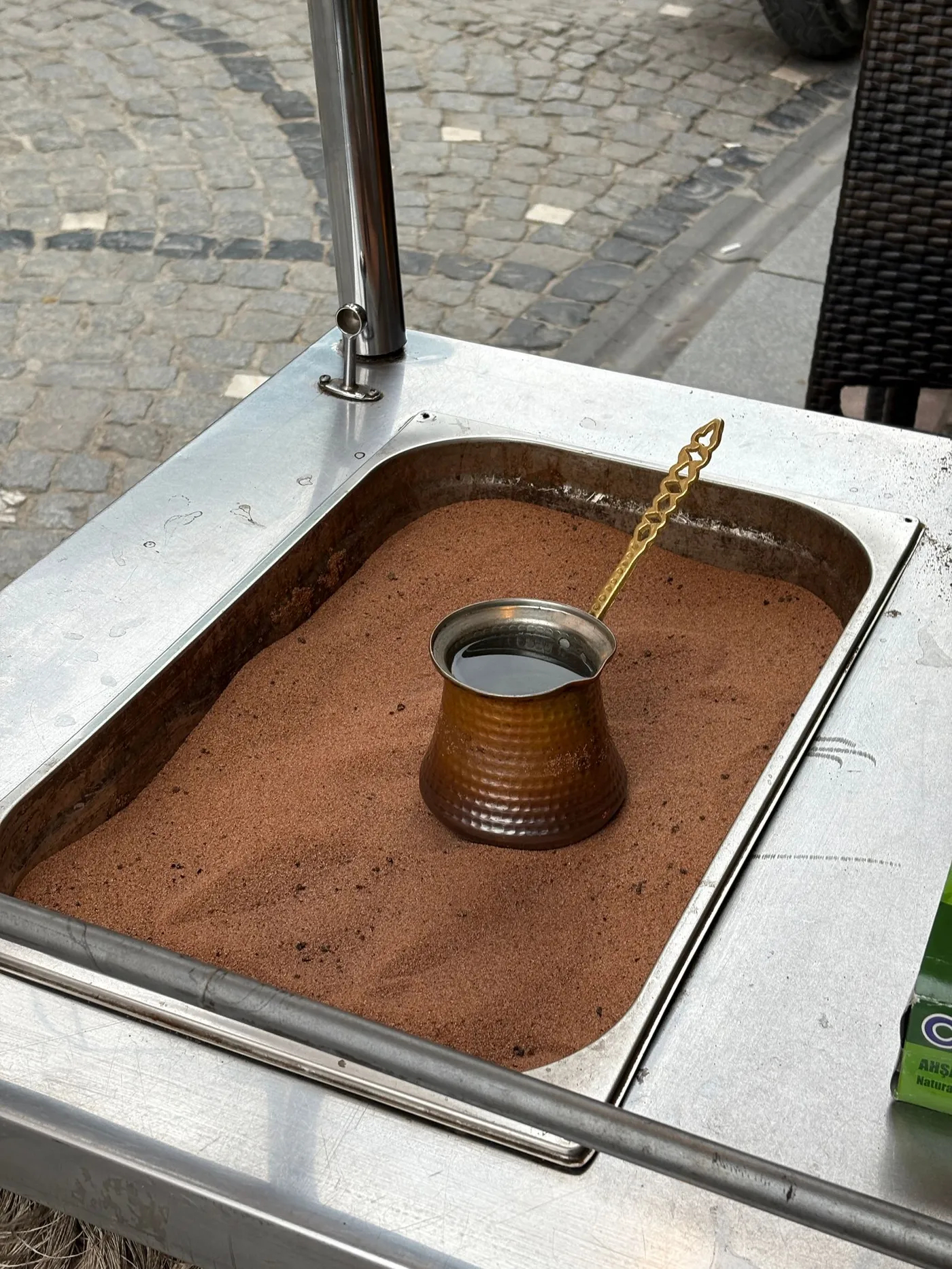
Half of it is. Arabic coffee names two drinks. In Lebanon, Syria, Jordan and Palestine it is the cup on this page: powder-fine coffee, often with cardamom, brewed in a rakweh and served with its foam. Ask for ahweh in Beirut and that is what you get.
In the Gulf, Arabic coffee means qahwa (or gahwa), and it is a related but different drink. The beans are roasted light, the coffee is spiced with cardamom and often saffron, and it is poured without its grounds from a tall dallah into small handleless cups, with dates alongside. It shares coffee's Yemeni roots and its place at the center of hospitality, but not the grind, the pot or the foam.
What About Bosnian and Armenian Coffee?
Both kept the method and added something of their own. Bosnian coffee changes the order: the water is heated in the džezva first, the coffee goes in off the heat, and the pot returns to the heat only until the foam rises. It comes to the table on a copper tray with a handleless fildžan, sugar cubes and rahat lokum, and it is drunk slowly.
Armenian coffee, soorj, is brewed in a jazzve the same way as Turkish coffee, and many families add cardamom. The grounds left in the cup are often turned onto the saucer and read, usually by the grandmother of the house.
More Than the Drink
Turkish coffee has always been more than what is in the cup: the slow brewing, the foam, the glass of water, the hospitality around the cup and the custom of reading the grounds. Gulf qahwa carries customs of its own, poured from the dallah as a sign of generosity. Two traditions, two drinks, both with roots in Yemen.
Which Coffee Works for All of Them?
Every cup on this page except Gulf qahwa asks for the same thing: coffee ground as fine as powder, so it can be brewed in a small pot and drunk unfiltered. The name on the pot changes. The coffee does not need to.
Lezzet Traditional is ground for exactly that. It starts with two specialty-grade arabicas, and a licensed Q Grader scored the coffee 84. The rich one is low in acidity, with notes of dark chocolate and nut, and we roast it dark for depth. The bright one we roast lighter to keep its lift, which puts the blend between the lighter Greek roasts and the darker Turkish ones. Each is roasted on its own, then blended, fresh-roasted in the USA in small batches and ground powder-fine. It goes into a cezve, a briki, a džezva or a jazzve just as it is.
For the Levantine or the Armenian cup, Lezzet Cardamom is the same blend with organic cardamom ground in. And if you are starting from nothing, the Turkish Coffee Kit puts a 12 oz cezve and all three flavors in one box. To brew it, our guide to how to make Turkish coffee covers every step, and what is Turkish coffee covers the rest of the story.
Coffee History FAQ
What is the difference between Greek and Turkish coffee?
Very little. Greek and Turkish coffee use the same powder-fine grind, the same small long-handled pot and the same slow heat, and both are served unfiltered with their foam. Greeks called it Turkish coffee until political tensions in the 1950s, and the events of 1974 in Cyprus, made "Greek coffee" the usual name. Greek brands tend to roast a little lighter.
Is Arabic coffee the same as Turkish coffee?
The Levantine kind, drunk in Lebanon, Syria, Jordan and Palestine, is the same method, usually with cardamom added. Gulf Arabic coffee, or qahwa, is a different drink: lightly roasted, heavily spiced, and poured from a dallah without its grounds.
Where did Turkish coffee come from?
Coffee drinking began in Yemen, where Sufi communities were drinking it by the late 1400s. It reached Istanbul by 1539, and the city's coffeehouses, the first recorded in 1554, made the powder-fine, slow-brewed cup an everyday ritual that spread across the Ottoman lands.
What is Middle Eastern coffee?
Usually it means the small, strong, unfiltered coffee made from powder-fine grounds in a long-handled pot, known as Turkish coffee in Turkey and as Arabic or Lebanese coffee in the Levant, often with cardamom.
Can one coffee make Turkish, Greek, Bosnian, Armenian and Arabic coffee?
Yes, for every cup in this family except Gulf qahwa. They all start with coffee ground powder-fine and brewed in a small long-handled pot, so one good powder-fine coffee works for all of them. Add cardamom for the Levantine or Armenian cup.